The Real Cost of NOT Having a Dealership Management System (DMS)
Jun 01, 2026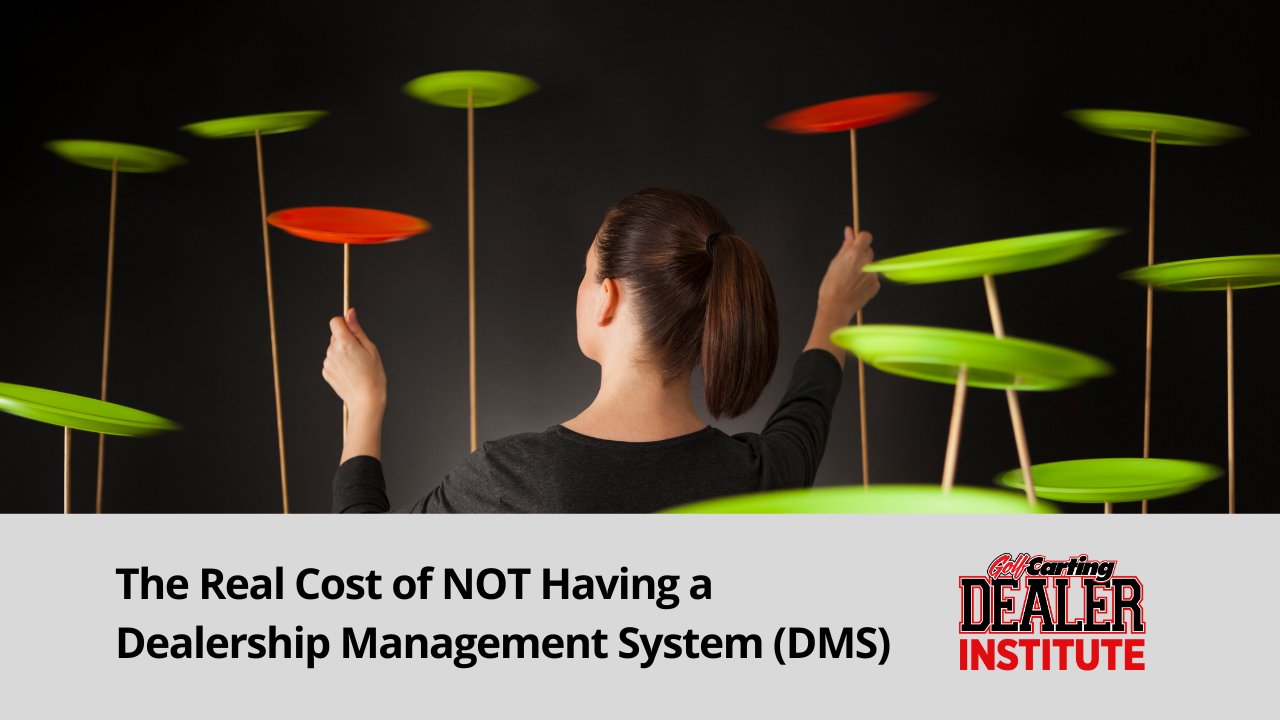
The Real Cost of NOT Having a Golf Cart Dealership Management System (DMS)
Have you ever seen a circus performer spinning plates?
They’ll start with one plate, then add a second one… then another… and another… until they’re surrounded by a growing array of spinning plates, constantly running from one to another trying to keep them all from crashing to the ground.
We hear a lot of golf cart dealers describe running their business the exact same way.
At first, managing the operation feels doable. A few service tickets. Some inventory. A handful of technicians. A couple of spreadsheets, maybe even QuickBooks. A whiteboard in the shop. Sticky notes on desks. Text messages between employees. Emails to customers.
But then the business grows.
More customers.
More carts.
More inventory.
More mods.
More technicians.
More moving parts.
And suddenly, it starts feeling like you’re running between spinning plates all day long, sometimes into the wee hours of the night, trying to keep everything moving without letting something fall.
Typically, this is the point where a dealer wonders not how much a golf cart Dealer Management System (DMS) costs, but how much is it costing the business NOT to have one?
As one of our dealers once put it: “The most expensive DMS we ever had was the one we didn’t.”
The More Your Dealership Grows, the More Plates You’re Spinning
One of the biggest challenges for golf cart dealers is that growth creates complexity.
As dealerships expand, so do the number of things demanding attention, at the exact same time.
Your service department needs customer approvals.
Your parts department is tracking inventory.
Sales is waiting on carts delivery.
Customers are calling for status reports.
Technicians need parts pulled.
Special orders are arriving.
Someone needs end-of-month reporting completed.
And meanwhile, everyone is trying to communicate using disconnected systems, manual processes, and gatekeepers inadvertently bottlenecking information access.
At first, dealerships can often manage this by working harder.
But eventually, working harder stops solving the problem.
Because the issue isn’t effort.
The issue is operational structure that’s impossible to scale.
Small Delays Become Expensive Problems
Most dealerships don’t lose money through one catastrophic issue.
They lose money through small inefficiencies repeated hundreds, or even thousands, of times over the year.
Let’s consider this real-world scenario.
If a technician earns the dealership $120/hour in billed labor and loses:
- 15 – 20 minutes per repair order
- due to waiting on approvals, parts order confusion, or communication delays
…and that happens:
- 5 or 6 times per day
- across 3 technicians
That equals:
4.5 lost labor hours daily
At $120/hour:
- $540/day
- ~$2,700/week
- ~$10,000+/month during peak season
Each issue might only take a few minutes.
But when your dealership is spinning dozens of operational “plates” every day, those minutes start compounding fast.
Suddenly, a DMS that costs a few hundred dollars per month doesn’t seem so expensive anymore.
Communication Breakdowns Slow Everything Down
Communication is one of the most common “plates” dealerships struggle to keep spinning.
Customers today expect fast updates and quick responses. They want transparency and convenience.
But many dealerships still rely heavily on phone calls for communication, and that often leads to the dreaded game of phone tag.
Modern dealership management systems with embedded texting capabilities help simplify this process dramatically and make communicating with customers so much faster.
Faster communication often means:
- faster approvals
- shorter repair cycles
- increased shop efficiency
- improved customer satisfaction
Take this real-life example.
A cart sits in a service bay waiting 24 hours for customer approval because:
- a voicemail wasn’t returned
- an email with an estimate wasn’t seen
- a staff member called and called and couldn’t get an answer
That service bay is now occupied by a non-producing job.
If embedded texting speeds approvals by even a few hours:
- technicians complete more jobs weekly
- bays turn faster
- throughput increases
If faster customer communication allows your shop to complete even 2 - 3 additional mods orders per week, that recovered revenue adds up quickly.
Inventory Problems Create More Spinning Plates
Inventory management is another area where dealerships often feel overwhelmed.
Golf cart dealerships manage a surprisingly large variety of products.
Without centralized inventory tracking, things can quickly become chaotic.
Dealerships may experience stock shortages, duplicate orders, inaccurate counts, delayed repairs, excess inventory, and lost sales opportunities.
When inventory information lives in spreadsheets, paper notes, or disconnected systems, employees spend more time searching for answers than serving customers.
That creates even more spinning plates for staff to manage.
Centralized inventory visibility allows employees to quickly see:
- stock levels
- purchasing history
- sales trends
- vendor information
- special order status
That visibility helps dealerships reduce costly mistakes and operate more efficiently.
Without centralized tracking, duplicate orders happen, dead inventory accumulates, and fast-moving parts go out of stock.
A single duplicate special order or missed inventory discrepancy can sometimes cost more than an entire month of DMS software.
Growth Without Systems Eventually Creates Chaos
One of the biggest operational traps dealerships fall into is assuming the processes that worked at a smaller size will continue working as the business grows.
But growth changes everything. It amplifies problems. It multiplies migraines.
What once felt manageable can suddenly become overwhelming.
- The owner becomes the “hub” for every decision.
- Employees rely on verbal communication, which leaves no tangible record.
- Processes become inconsistent and potentially recipes for disaster.
- Information gets duplicated, lost, or is downright inaccurate.
- Departments operate independently instead of collaboratively.
And eventually, it starts feeling like the entire dealership depends on one or two people who are constantly running around trying to keep every plate spinning.
That approach isn’t sustainable long-term for your business.
A dealership management system helps create operational consistency by connecting departments and centralizing information into one platform.
Instead of everyone operating independently, your sales, service, parts, and management team all work from the same real-time information.
That reduces confusion, improves accountability, and helps dealerships scale more effectively.
The Cheapest Option Isn’t Always the Best Value
Some dealerships realize they need software but choose systems based entirely on the lowest price.
Unfortunately, the lowest price doesn’t mean the greatest value.
Many software providers that charge a low price have additional fees for:
- setup
- onboarding
- data migration
- training
- support
- integrations
Long-term contracts can create even more frustration.
Some dealerships find themselves locked into multi-year agreements with software that no longer fits their needs by year two of a five-year contract, or they get stuck with support teams that become difficult to reach after implementation.
That’s why transparency matters.
Before choosing a dealership management system, dealerships should ask:
- Are there hidden fees?
- Is support included?
- Does training cost extra?
- Is there a contract?
- What features add to the price?
- How difficult is it to cancel?
Software providers should earn your business through performance and support and not by trapping dealerships in restrictive agreements.
A DMS Helps You Stop Running Between Plates
At the end of the day, a dealership management system is about more than software.
It’s about creating operational stability.
It helps dealerships reduce chaos, improve communication, streamline workflows, and create more visibility across the business.
Because the reality is this:
The more your dealership grows, the more plates you’re spinning.
And eventually, trying to keep everything moving manually becomes exhausting, inefficient, and expensive.
A dealership management system helps bring those moving pieces together into one connected platform.
That way, your team can spend less time trying to keep plates from falling and more time focusing on growth, customer experience, and profitability.
About BiT Dealership Software, Inc.
Founded in 1985, BiT Software provides a cloud-based dealer management system that helps golf cart dealerships operate more efficiently and profitably. Its comprehensive platform integrates sales, service, parts, and more, supported by a team dedicated to dealer success. Headquartered in Knoxville, Tennessee, BiT is surrounded by some of the most renowned recreational vehicle manufacturers in the world and a thriving outdoor recreation community.
Learn more at bitdms.com/golf-cart/
Contact:
Aaron Killian, Marketing Manager
865-686-6544 ext 104
[email protected]